Do Goldfish Need Light at Night? The Short Answer
Ask whether goldfish need light and two camps start shouting past each other. One treats the aquarium light like medical equipment the fish cannot live without, while the other insists goldfish prefer darkness and every lit hour is stress.
The truth is calmer than either camp. Goldfish need a day and a night, in that order, every day. The fixture matters far less than the rhythm, and the night half of that rhythm is the half most tanks get wrong.
At night, the answer is off
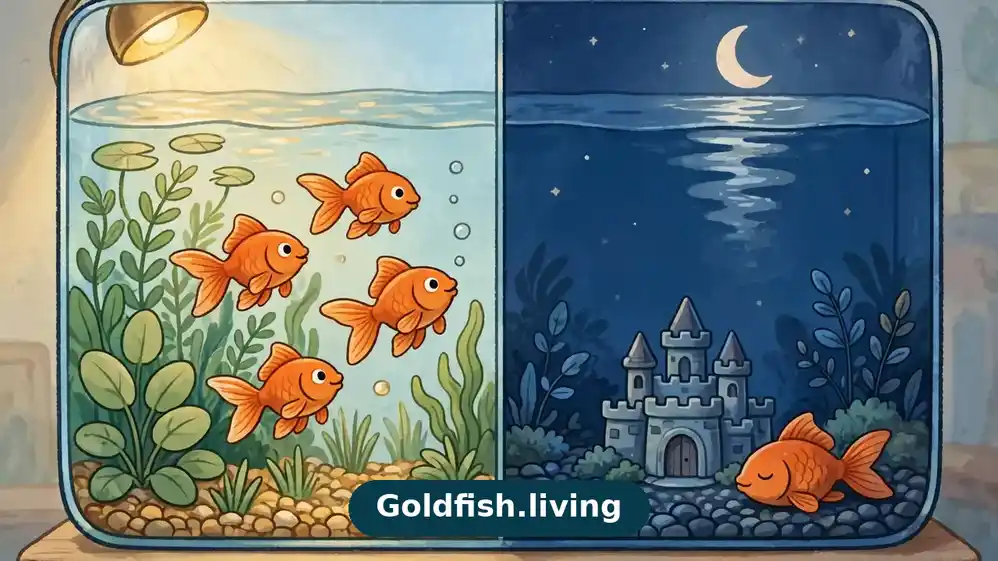
Goldfish do not need light at night. They need the opposite: a dark stretch of roughly 12 hours with the tank light off, every single night.
Darkness is when goldfish rest, and rest is tied directly to their immune system, their behavior, and how well they handle everything else in their lives. The Environmental Literacy Council puts it plainly: constant bright light stresses goldfish the way it would stress you, disrupting rest patterns and natural behavior.
An aquarium light is a daytime tool. At night, off means off, and a completely dark room is not a problem to solve. It is the treatment.
No eyelids means no escape from a lit tank
Goldfish cannot close their eyes, so they cannot shut light out the way you can. Under a tank lit around the clock, a fish never receives a clean signal that the day is over.
Their bodies run on a circadian rhythm much like ours, and that rhythm needs a dark phase to stay regulated. In proper darkness, goldfish hover quietly, slow down, and become less responsive to the room, which looks like nothing and is actually maintenance.
A fish that never gets darkness never gets real rest, and the bill arrives as chronic stress and weaker immunity. Our guide to how goldfish rest shows what healthy downtime looks like, so you can separate a resting fish from one that is hiding because something is wrong.
How much light the day side needs
Most guidance lands in the same range: 8 to 12 hours of light, then dark for the rest. The RSPCA recommends artificial light during the day on a steady cycle of about eight to ten hours, switched off at night, and plenty of keepers run ten to twelve without trouble.
Consistency beats precision. A timer that flips the light at the same times daily is worth more than a theoretically perfect schedule you keep forgetting, and fish settle into a predictable cycle within a week or two.
Remember that room daylight counts toward the total. A tank in a bright living room already gives the fish a day and a night with no fixture at all, because the tank light exists mainly for your viewing and for the plants. The fish are not waiting for you to switch it on.
What fourteen hours of light does
Algae is the visible bill for overlighting. Light plus nutrients grows it, and a tank lit fourteen or sixteen hours a day usually grows algae faster than you can scrape it off. Goldfish produce waste in quantity, which means nutrients in quantity, so an overlit goldfish tank tends to show the green sooner than most.
Cleanup crews help at the margins, and our guide to the best algae eaters for a goldfish tank covers the options, but the actual fix is dialing the lit day back to eight or ten hours.
The subtler cost is behavior. Fish under constant bright light may hide more, eat with less enthusiasm, or act in ways that look like early illness. If the water tests clean and the fish still seems off, ask when the tank last had a full dark night, because the answer is often never and the fix costs nothing.
Heat is the forgotten cost. Older fluorescent and incandescent fixtures warm the water noticeably, and goldfish want their water cool and stable. LEDs run far cooler, which is one reason they have become the default for freshwater tanks.
The other extreme is real too
Kept in near-total darkness for weeks, goldfish fade. Their pigment cells respond to light, and without that stimulation new pigment stops forming at the normal rate, so a fish in a dark basement tank often looks paler after a month.
Darkness also blinds the keeper. In a tank you cannot see into, you miss the first white spot, the uneaten food rotting in a corner, and the water quietly going cloudy.
A fish kept in a dim room for months is not resting better; it is living without a day. Pigment, activity, and the whole daily routine run on the contrast between light and dark, not on darkness alone.
None of that argues for intense lighting. Ordinary room light on a normal cycle is plenty for the fish themselves, and the tank light stays what it always was: a supplement for viewing and plants, not life support.
Choosing a light without overthinking it
LED is the sensible default: efficient, long-lived, and cool-running, which helps hold water temperature steady. A full-spectrum or daylight LED around 5500 to 6500 Kelvin approximates sunlight and shows the fish’s colors honestly.
Skip the novelty settings as a permanent arrangement. Blue moonlight modes and color-cycling displays may suit an evening, but the fish register dim blue light as light, so an all-night glow is a lit night as far as their rest is concerned. Run it for an hour of viewing, then switch everything off.
The best accessory is a cheap outlet timer. Set it once and the tank gets the same day length in December as in June, whether you remember or not. Start brightness in the middle if it adjusts, watch for a week or two, then shorten the day if algae explodes or lengthen it slightly if plants stall while algae stays calm.
Sunlight is the one source to refuse
Direct sun is the exception to every relaxed rule above. A tank in a sunny window heats fast, grows algae enthusiastically, and swings temperature in ways goldfish hate, which is exactly why the RSPCA warns against window placement.
Bright indirect room light is fine, even pleasant. Many keepers run tank lights only in the evening for viewing and let daylight carry the rest of the cycle, which works as long as the bright total stays within 8 to 12 hours and the night is genuinely dark.
Plants are the one real reason to take the fixture seriously. Most aquarium plants want 8 to 10 hours of decent light, and hardy species like anubias and java fern cope with modest levels. If plants stall while algae blooms, the answer is rarely more light; it is usually fewer nutrients, through water changes and tighter feeding.
Questions about goldfish and light
Do goldfish need light at night?
No. They need darkness at night to rest properly, roughly twelve hours of it. Leave the tank light off overnight, because a fully dark room is fine, and the fish settle into the routine within days.
Will my goldfish be okay with no tank light at all?
Yes, provided the room itself runs a normal day and night. Daylight in the room by day and darkness at night is a complete cycle for the fish. The tank light is optional equipment, bought for viewing and plants.
Can I leave the blue moonlight mode on all night?
Better not. Fish perceive dim blue light as light, so it interrupts rest much like a dim white light would. Use moonlight for an hour or two of evening viewing, then give the tank a fully dark night.
Exactly how long should the lights stay on?
Somewhere between 8 and 12 hours. The RSPCA suggests eight to ten for most setups, and many goldfish keepers land near ten. Pick a number, put it on a timer, and stop adjusting it every week.
Is it okay to switch the tank light on suddenly at night?
Occasionally, but expect a startled fish. Goldfish cannot shield their eyes, so a blast of light in a dark room is genuinely unpleasant for them. Turn on a dim room light first, and use the tank light only if you really need to look.
One habit solves the whole question
Everything above reduces to a single routine: 8 to 12 lit hours on a timer, then a dark tank until morning. PetMD’s fish care resources back the same priority, stable and predictable conditions over gadgetry.
Fixture brand, color temperature, sunrise modes: all of it is decoration on top of that one habit. Get the rhythm right and lighting stops being a question at all.