Male vs Female Goldfish: 5 Ways to Tell Them Apart
Sooner or later every goldfish keeper leans on the glass and asks it: are you a boy or a girl? The fish, unhelpfully, looks exactly the same either way.
Sexing goldfish is a genuine skill, but it is a seasonal and comparative one. The clues are real, they are just subtle, they hide for most of the year, and they vanish entirely in young fish.
What follows is the working method experienced keepers use: five checks, ranked by how much you should trust them, plus the honest limits of each. Stack the clues together and you will be right far more often than not.
Start with the calendar, not the fish
Timing decides how much evidence exists. Goldfish reveal their sexes in breeding season, late spring into early summer, when warming water triggers the changes: males grow breeding tubercles and start chasing, females swell round with eggs.
Outside that window you are reading leftovers. The fish also need to be mature, at least a year old and preferably two depending on the breed, before any of the traits below are developed enough to read.
The firm rule underneath everything: a goldfish under a year old cannot be sexed reliably. Anyone who sexed your two inch juvenile at the shop was guessing, whatever their confidence suggested.
Fancy breeds add one more layer of difficulty. Round bodies in both sexes blur the shape clues, so a ranchu or oranda will keep its secret longer than a slim common goldfish will.
Breeding tubercles: the closest thing to proof
During spawning season, male goldfish grow breeding tubercles, small white bumps arranged in fairly regular rows on the gill covers and along the leading edge of the pectoral fins. Find clear tubercles in spring and you are almost certainly looking at a male.
The rows matter, because tubercles get confused with white spot disease, and the confusion runs treatment in exactly the wrong direction. Tubercles sit in neat, symmetrical patterns on the gills and fin rays; ich looks like salt scattered at random over the whole body and fins.
Three honest limits apply. Tubercles only appear in season, so this check is useless in winter.
Some females grow a few small ones, sparser and fainter than a male’s. And young or low ranking males may show barely any.
Even with the caveats, prominent tubercles in spring are the strongest single clue available. The PetMD goldfish care guidance describes the same seasonal markers, and they remain the method to trust first.
The video below shows spawning season behaviour up close, which helps when you are comparing tubercles and chasing in your own tank.
Shape: a clue that needs a fair comparison
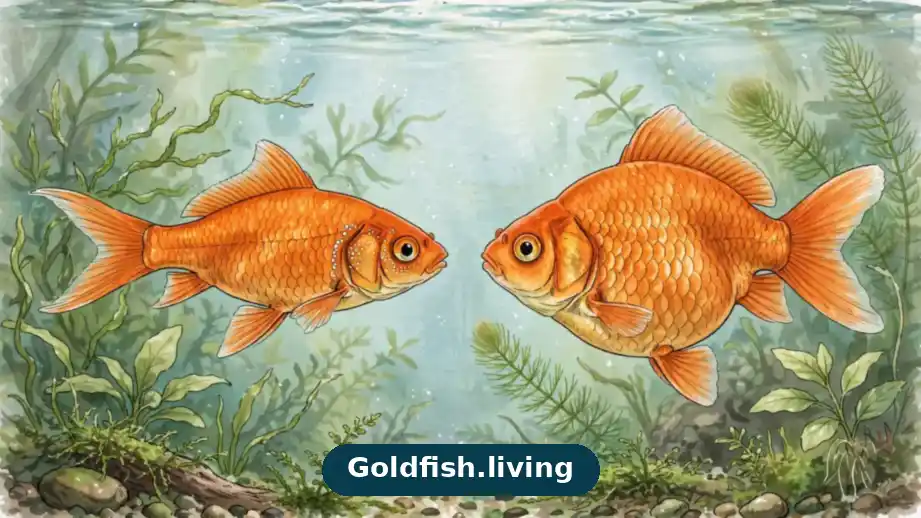
Females run rounder and deeper bodied than males of the same breed and age. From above, a mature female looks plump through the midsection where a male looks slimmer and more streamlined, and from the side her belly sits fuller.
The difference peaks in breeding season, when a female filling with eggs can look dramatically rounder than she did a month earlier. That seasonal swelling is itself one of the better clues on this list.
As a standalone test, though, shape is the weakest of the five. A well fed male looks round, a young female looks slim, and fancy breeds are round in both sexes by design.
Use shape only as supporting evidence, and only between comparable fish: same breed, similar age, same feeding. A rounder fantail beside a slimmer fantail tells you something. A round ranchu beside a slim comet tells you nothing at all.
The vent, checked without a chase
The vent is the small opening on the underside, between the pelvic fins and the anal fin. On a mature female it tends to be rounder, slightly larger, and gently protruding, most noticeably in breeding season.
On a male it is usually smaller, tighter, and more concave. Read side by side on two mature fish in spring, the difference is learnable; read on one fish in autumn, it is close to guesswork.
A photograph taken from below, quickly and gently, lets you study the vent without holding the fish still for an inspection. Breeders use exactly this trick during sorting season.
What you should not do is chase the fish around the tank or lift it out of the water for a better look. Netting and flipping a goldfish stresses it and risks its fins and slime coat, so if the vent cannot be seen during normal viewing, let the question wait.
Fins and the chase: supporting evidence
Male goldfish often carry longer, more pointed pectoral fins, while females’ are shorter and rounder. During breeding season the male’s fins also carry the tubercles along the leading ray, which turns this weak clue into a much stronger one.
Behaviour is the clue that settles arguments. In spring, males chase females persistently, nudging at their bellies and vents to encourage egg release, and the fish doing the chasing is the male.
That chasing alarms new keepers because it looks like bullying, but it is normal spawning behaviour with a clear seasonal pattern. Our guide to why goldfish chase each other walks through how to tell a spawning chase from genuine aggression.
Behaviour has its own limits: it mostly happens in season, young males chase before they show tubercles, and single sex tanks can produce confusing rehearsals. Sustained belly nudging chases in spring, though, are about as reliable as evidence gets.
The background mood shifts too. Males often become generally more active and territorial through the season, patrolling and investigating, while females stay comparatively calm until the chasing starts. It proves nothing alone, but as a supporting observation it points the same way as the fins.
Eggs or milt settles it
One method removes all doubt, and it requires watching an actual spawning. Females release eggs, small sticky amber spheres that cling to plants and decor, while males release milt, a whitish fluid that clouds the water.
Eggs mean female and milt means male, with no exceptions and no interpretation. The catch is obvious: you need the right conditions and a willing pair, which most keepers neither stage nor need.
For everyday purposes, tubercles plus chasing in spring is conclusive enough to act on. Save the certainty standard for deliberate breeding projects.
Rules that sound right and are not
The hobby repeats a few confident rules that collapse on inspection. Colour is not a sex indicator in goldfish: the bright males and dull females idea is a myth carried over from other fish.
Size is not reliable either, because the larger fish in a tank is usually just the older or better fed one. And the claim that only males ever grow tubercles is mostly true rather than fully true, which is why a couple of faint bumps should never be treated as a verdict.
The deepest myth is the pet shop promise itself, that any goldfish on sale can be sexed on the spot. For juveniles it cannot, and honest uncertainty now beats false confidence you build a breeding plan on later.
Why it rarely changes the care
For most keepers, the answer changes nothing. Males and females need identical care, eat the same food, and live in the same water, and goldfish lifespan depends on tank size and water quality rather than sex, as the goldfish lifespan guide sets out.
Sex matters for exactly one project: breeding, where you need at least one confirmed fish of each sex. If fry arrive, willingly or not, our notes on what goldfish fry eat cover the first weeks of feeding them.
Keepers who would rather avoid fry have simple levers. Hold spring temperatures steady and skip the large, cooler water changes that can trigger spawning, and know that eggs laid in a community tank are usually eaten quickly, which is simply what happens.
There is no need to separate the sexes for everyday keeping. The only reason to intervene is a female being chased to exhaustion or injury, and that is a welfare decision, not a sexing one.
Sexing questions, answered straight
Can you tell the sex of a baby goldfish?
Not reliably, whatever the shop assistant said. Juveniles under a year old have not developed tubercles, mature body shapes, or readable vents, so every method in this guide returns a guess. Wait for the fish to pass through a breeding season at a mature size before deciding.
Are breeding stars the same as breeding tubercles?
Yes, two names for the same structures: the small white bumps on a male’s gill covers and pectoral fin edges during spawning season. They fade once the season ends. The name changes, the check does not.
Will two male goldfish fight each other?
Generally no. Goldfish are peaceful fish, and males live together without drama outside some chasing and mild sparring in breeding season. Single sex groups, mixed groups, and pairs all work in a properly sized tank.
Can a goldfish change sex as it grows?
No. A goldfish’s sex is fixed for life, a point the RSPCA’s fish care guidance and other welfare references treat as settled biology. If a fish you recorded as female starts showing tubercles and chasing, the earlier reading was wrong, which the subtlety of the clues makes entirely forgivable.
Do goldfish need a mate to be content?
No. Goldfish are social with their own kind generally, but nothing in their welfare depends on having an opposite sex partner. Company, space, and clean water make a goldfish content; a breeding partner is optional.
Wait for spring
Sexing goldfish rewards the keeper who can leave the question open. Note the clues you have, refuse the ones the season has not provided yet, and let the fish finish growing up.
Keep rough notes through one spring: which fish grew the bumps, which one swelled, which one did the chasing. A single season of notes turns next year’s reading from guesswork into recognition, because you will be comparing each fish against its own history.
Then spring arrives, the water warms, and the tank answers the question itself: bumps on the gills, a rounder silhouette, and one fish chasing another with unmistakable purpose. Winter hides what the fish are. Spring does not.




One Comment