Why Is My Goldfish Turning Black? Causes Explained
Black patches spreading across a goldfish can look like the start of something dreadful, especially when they arrive over a few days. Your bright orange fish develops dark smudges on its fins, body or gill covers, and the obvious fear is that it is rotting or dying. Most of the time it is neither.
Black on a goldfish is a clue with several possible authors: healed burns, ordinary genetics, recovering injuries, chronic stress, and one rare parasite. The trick is reading the pattern of the marks before reacting to the colour itself, because each pattern has its own answer.
Read the pattern before you read the colour
Three questions sort most cases before any test kit comes out. Did the black arrive as smudgy patches on edges and gill covers, as smooth colour spreading inside the scales, or as tiny raised dots? And how fast did it come: days, or months?
Smudges on fin edges after a rough week in the tank usually mean healing burns. Smooth, slow darkening in a young fish that acts perfectly healthy usually means genetics. Raised pinhead dots are the only pattern on this list that suggests a parasite, and they are rare indoors.
One more pattern question: how many fish are affected? Several fish darkening together points to a shared event in shared water, because genetics does not synchronise across a tank. A single fish changing alone, slowly, while tankmates stay bright points back toward that fish’s own history or bloodline.
Whatever the pattern, test the water while you think. It takes five minutes, costs nothing, and either rules out the one dangerous cause or hands you the fix for it.
Black smudges after a bad week: healing ammonia burns
The most common reason goldfish turn black is ammonia exposure that has already happened. Ammonia burns skin, fins and gills, and as the damaged tissue heals it often darkens with melanin, the same pigment response that darkens a healing scar. Those smudges are, quite literally, the visible record of a chemical burn repairing itself.
Why the colour shows up late
The delay is what confuses keepers. The spike happens, the fish suffers quietly, the water clears, and a week or two later the black appears as healing begins. By then the tank may test perfectly clean, and the keeper blames the food or the light while the real culprit sits in last fortnight’s history.
Reconstruct that history honestly. A new tank still cycling, a filter that stopped or was rinsed under the tap, an overstocked spell, one heavy-handed weekend of feeding: any of these can spike ammonia hard enough to burn. Check nitrite too, since nitrite trouble follows ammonia trouble in cycling tanks.
What healing burns need from you
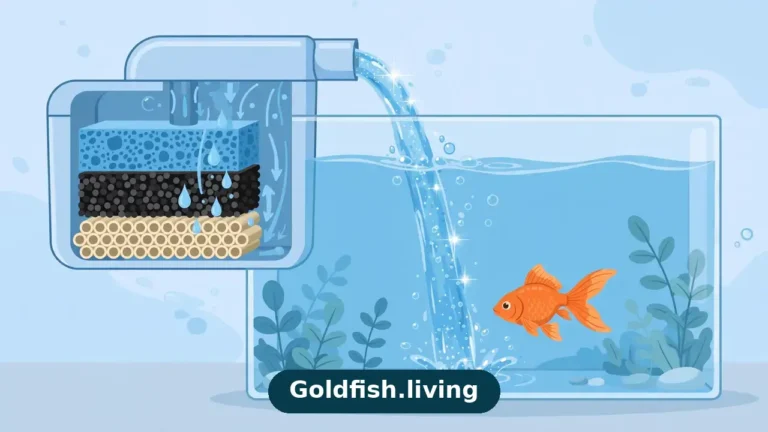
They need clean water and time, nothing more exotic. Keep ammonia and nitrite at zero with partial changes of dechlorinated water, and review the maintenance routine that allowed the spike. Our goldfish water parameters guide sets out the numbers a healing fish should be living in.
The patches themselves usually fade over weeks to months as tissue fully repairs, though a faint shadow can stay. There is no medicine for a healed burn, and dosing one anyway only stresses the fish. Spend the effort on preventing the next spike.
The slow, harmless kind: colour change in young fish
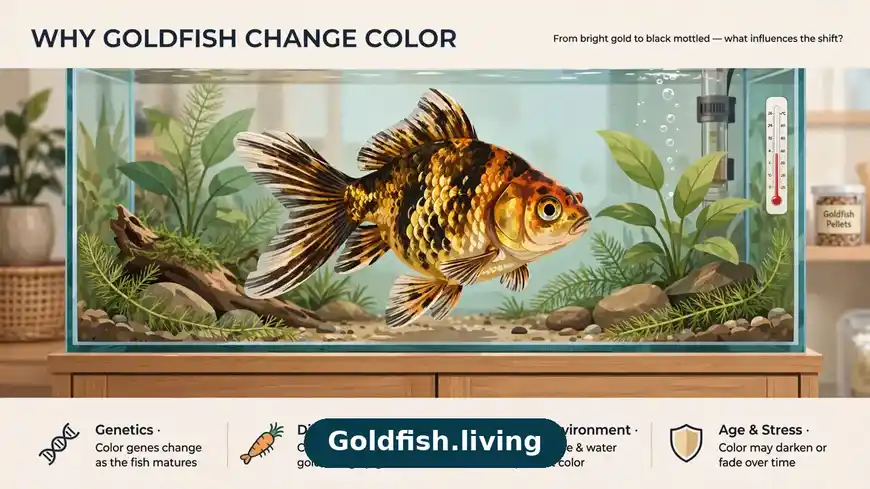
Goldfish are famous for changing colour as they mature, and black is one of the commonest directions. Many orange juveniles develop black patches, black fin edges, or turn substantially dark through their first year or two. Some lighten again toward orange, red or white as adults.
It is written into the bloodline, the way some dog breeds change coat as they grow. Black moors are the obvious example of black by design, but ordinary fantails, ryukins and commons pass through dark phases too.
Natural change announces itself by what is missing. The fish eats eagerly, swims normally, holds its fins out, and shows no gasping, clamping or lethargy. The dark colour sits smoothly within the scales rather than looking raised, fuzzy or eaten away, and it spreads over weeks to months, not days. A fish under two years old, changing slowly, with a clean test kit, is a genetics case until proven otherwise.
Dark marks where a wound used to be
Any skin damage can darken as it heals, not just burns. A scrape from sharp decor, fin nips from a tankmate, or the mark left by a resolved ulcer often goes through a dark phase on its way back to normal. It is the same melanin response, arriving from a different injury.
Look for the story behind the mark. A black-edged patch sitting exactly where a wound was last week is a repair site, and the correct response is to remove the original cause: smooth the decor, separate the nipper, keep the water clean so healing tissue stays uninfected.
Healing should look smooth and shrink or fade steadily. If the area instead grows, turns fuzzy or cottony, or develops red edges while the fish’s behaviour slides, the wound has likely become infected. That situation follows the logic of our goldfish fin rot treatment guide, because secondary bacterial infections are handled the same way.
A whole fish gone dusky: the stress signal
Sometimes there are no patches at all, just a fish whose whole colour has gone darker and duller. Chronic stress can do that. Aggressive tankmates, cramped quarters, strong current, or water quality that swings instead of holding steady all push a fish’s body into a prolonged strain response, and a duskier cast is part of it.
The fix is environmental detective work, not medication. Review stocking against tank size, watch for chasing you might be missing, and check that the filter outflow is not blasting the fish around its own home. When the stressor lifts, colour often brightens back over several weeks.
Diet and light play smaller supporting roles. Colour-enhancing foods rich in carotenoids deepen reds and oranges, a bland diet lets colours drift, and dim tanks tend to deepen colour while bright light brings out lighter tones. None of these creates black patches on its own, but a varied diet and ordinary aquarium lighting keep colour honest. The basics are covered in our goldfish care guide.
Raised black dots are a different story
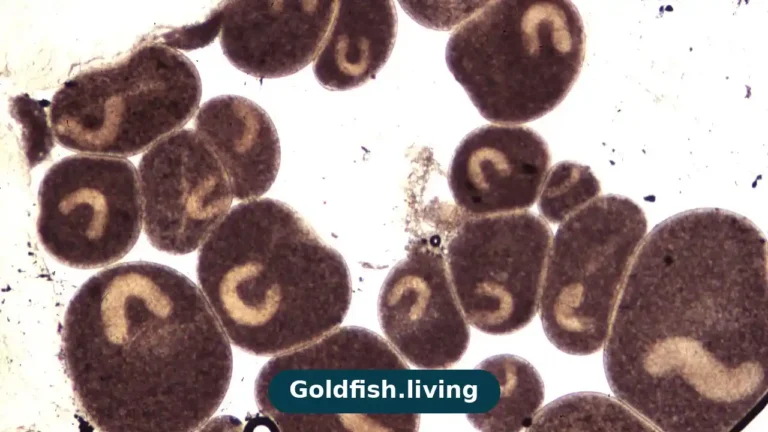
True black spot disease comes from parasitic flukes whose larvae burrow into the skin and form small black cysts. It is far rarer in indoor aquariums than search results suggest, because the parasite needs snails and birds to complete its life cycle. It belongs mostly to ponds and wild-caught fish.
The cysts look like tiny raised black dots, each about pinhead size, scattered over body and fins, and affected fish often rub against objects. A goldfish that has lived its whole life indoors, with no pond-raised newcomers, almost certainly does not have it.
Where it does occur, breaking the snail link breaks the chain: remove snails, and in ponds limit bird access to the water. Do not medicate for it on a guess. The treatments are harsh, the diagnosis is uncommon, and a misread case of healing burns will not be helped by them.
When black patches stop being a wait-and-see problem
Most black colour is slow and benign, but some combinations demand speed. Darkening that arrives with red gills, gasping at the surface, sudden lethargy, appetite loss or visible sores suggests active ammonia or nitrite poisoning happening now, not history healing. Change 30 to 40 percent of the water immediately with dechlorinated, temperature-matched water, keep testing daily, and check the filter is running and the tank is not overstocked.
Raised black lumps, spreading ulcers, or tissue that looks dead rather than dark are beyond home care. The Merck Veterinary Manual’s aquarium fish section notes that bacterial infections in fish often need professional diagnosis before treatment can succeed, and necrotic tissue is exactly that territory.
Suspected black spot disease after adding pond-raised fish is another vet conversation, this time for confirmation before anyone treats. The RSPCA’s fish care guidance lists the warning signs that separate watchful waiting from urgent attention, and the PetMD fish care library gives you the healthy baseline to compare against. For finding a clinician who actually sees fish, the AVMA’s pet owner resources are the practical starting point.
Questions about goldfish turning black
Why did the black appear so suddenly?
Blackening over days usually traces to an ammonia spike from one or two weeks earlier, whose burns are now darkening as they heal. Work backwards through recent history: new fish, missed changes, a filter incident. Blackening over months in a young, thriving fish points the other way, toward ordinary colour change.
Will the dark patches fade, or is this permanent?
Burn marks and healing injuries typically fade across weeks to months once the water stays clean, though a faint trace can remain for good. Genetic colour change is simply the fish’s adult colour arriving, and there is nothing to reverse. Patches that keep spreading in clean water deserve a deeper look for an ongoing cause.
Does a black goldfish need medicine?
Almost never for the colour itself. The common causes, healed burns, genetics, healing wounds, involve no active pathogen for medicine to act on. Test the water first and medicate only a disease you have actually identified, because unnecessary chemicals are their own stressor and a frequent beginner mistake.
Can bad lighting or food turn a goldfish black?
They can shift overall tone, deepening or dulling it, but they do not paint patches on a fish. Patch-shaped black means tissue history: a burn, a wound, or genes switching on. If the marks have edges and locations, look for an event, not a lamp.
My black moor is hard to read. How do I spot trouble?
Black moors are black by genetics, so burns hide on them. Judge by behaviour and water instead of colour: appetite, swimming, fin position and gill speed, backed by a regular testing routine. On a dark fish, those signals carry the information that colour carries on an orange one.
The 24-hour watch
When you cannot yet name the cause, run one full day of watching before you run any treatment. Across 24 hours, note three things: whether the black is spreading, whether the edges look smooth or angry, and whether the fish is eating and swimming like itself.
Healing and genetics sit still or improve across that window; active poisoning and infection do not. A stable fish with clean tests earns more watching. A spreading patch on a fading fish has finished the observation phase and started the action one.