Best Filter for Goldfish Tanks: Types, Sizing, and Maintenance
Ask experienced goldfish keepers what matters most and filtration comes up within the first minute. Goldfish eat constantly, produce a heavy waste load, and can foul a tank faster than almost any other common aquarium fish.
That is why filter choice matters more for goldfish than for most freshwater fish. The right filter holds ammonia at zero between water changes, while the wrong one leaves you fighting cloudy water and sick fish no matter how often you clean.
Why goldfish outgrow ordinary filters
It comes down to biology. Goldfish have fast metabolisms and inefficient digestion compared with many tropical fish, so they excrete more ammonia per unit of body weight, and ammonia is the first and most toxic stage of the nitrogen cycle.
A filter’s real job is not clear water but surface area, where beneficial bacteria convert ammonia into nitrite and then into far less harmful nitrate. Clear water with no bacterial colony is still dangerous water, which is why looks are never proof a filter is working.
Sizing follows from that mismatch. A filter rated for a 30 gallon community tank may be barely adequate on a 30 gallon goldfish tank, because the waste load is simply in another league.
Three jobs inside one box
Mechanical
Mechanical filtration traps solid particles: uneaten food, fish waste, and plant debris. Sponges, pads, and floss do this job, and it is what makes water visibly clear.
It runs first in most filters because removing solids protects the finer media downstream. For goldfish there is simply more debris, so a filter that clogs every few days is telling you it is undersized.
Biological
Biological filtration is the life-support system. Beneficial bacteria colonize the media and process ammonia into nitrite, then nitrate, and that colony is the single most valuable thing in the tank.
More media surface area means a bigger, more stable colony. Filters with generous media capacity outperform compact ones on goldfish tanks because goldfish produce enough ammonia to need every bit of that room.
Chemical
Chemical filtration uses media like activated carbon to remove dissolved organics, odors, tannins, and medication residues. It polishes water beautifully, but it is optional in most established tanks and the media needs regular replacement to keep working.
Never lean on chemical media to rescue an undersized filter. Carbon cannot replace a bacterial colony, so get the biology right first and add polishing media only if you want the extra clarity.
Four types, judged by waste load
Hang-on-back filters
HOB filters hang on the tank rim, pull water up an intake tube, and pour it back over a spillway. They are the most popular choice for small to medium goldfish tanks: affordable, easy to install, and simple to service because the media box lifts right out.
The spillway return is an underrated bonus, since it agitates the surface and boosts oxygen exchange automatically. For tanks up to about 40 gallons, a quality HOB sized one step above the tank volume is a solid choice.
One caution: most HOBs ship with disposable cartridges, and replacing the cartridge throws your bacterial colony away with it. Swap the cartridge for permanent foam and ceramic media and the same filter becomes far more capable.
Canister filters
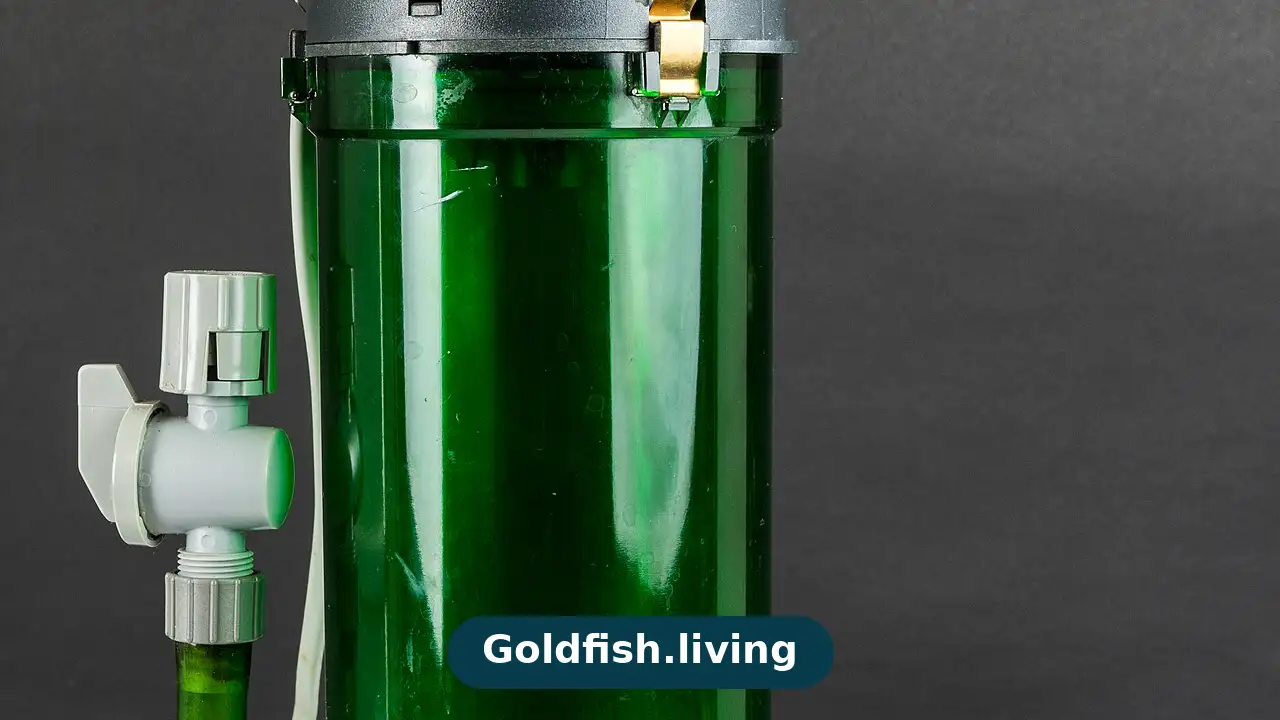
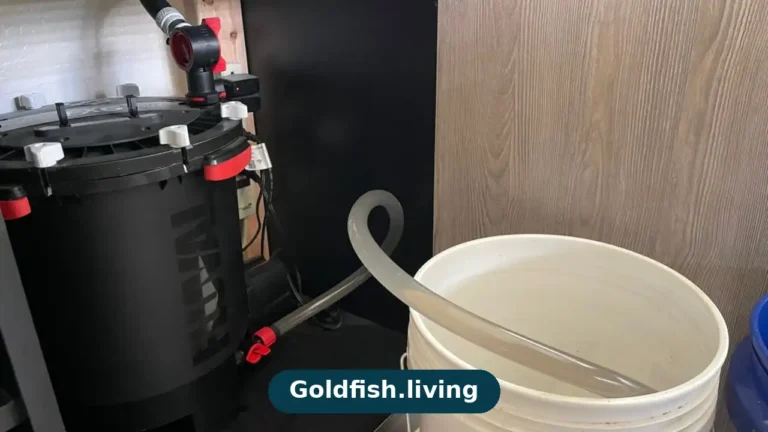
Canister filters sit in the cabinet below the tank and push water through stacked trays of media. They hold far more media than any HOB, which means a bigger bacterial colony and longer intervals between cleanings.
For goldfish tanks of 40 gallons and up, a canister is the gold standard, and on a 55 or 75 gallon tank it handles heavy waste with ease. The trade-offs are price, several times an HOB, and a servicing job that means disconnecting hoses and hauling a dripping canister to the sink every 2 to 3 months.
Sponge filters
Sponge filters are the humble workhorses of the hobby: a block of foam driven by an air pump, with water drawn through by rising bubbles. They provide outstanding biological filtration for their size, cost almost nothing, and produce the gentle flow that fancy goldfish love.
Their weakness is mechanical filtration, because fine particles pass through the coarse foam and the water may never look polished. They also sit inside the tank, which some keepers dislike, and they need an air pump running constantly.
Where they shine is as backup filtration alongside a HOB or canister. A second, independent bacterial colony keeps the cycle alive if the main filter fails or needs servicing, and many goldfish keepers treat that redundancy as essential rather than optional.
Internal filters
Internal filters sit fully submerged inside the tank, usually suction-cupped to the glass. They are cheap and simple, and they work acceptably in small tanks, but their media volume is limited and they take up swimming space.
For goldfish they are mostly a temporary or supplementary option, useful in a quarantine tank or to add circulation in a dead spot. The bioload is too heavy for a small media chamber to serve as the primary filter.
Sizing without guesswork
The classic goldfish rule is a filter rated for roughly twice the tank volume, or a turnover of 4 to 6 times the tank volume per hour. A 30 gallon goldfish tank wants a filter rated for 55 to 75 gallons, moving 120 to 180 gallons per hour.
Some keepers push toward 10 times turnover, and the caution behind it is real: manufacturers rate filters under ideal conditions. Real tanks have media, gunk, and head pressure, so actual flow is always lower than the box claims, and sizing up compensates for the gap.
Watch the fish, not just the numbers. Fancy goldfish are weak swimmers, so if the current pins them in a corner, baffle the outflow or switch to a gentler setup, because strong filtration should clean the water, not exhaust the fish.
The biology behind these numbers is standard aquarium science, set out in the Merck Veterinary Manual’s aquarium fishes section. PetMD’s fish care library likewise stresses filtration and water quality as the foundation of goldfish health.
Cleaning that keeps the colony alive
Here is the rule that saves more tanks than any product: never rinse filter media in tap water. Chlorine and chloramine kill beneficial bacteria on contact, and wiping out the colony causes the exact ammonia spike the filter exists to prevent.
Rinse media instead in a bucket of old tank water during a water change. Squeeze sponges until the water runs relatively clear, swish ceramic media gently, and put everything straight back, so the debris leaves and the bacteria stay.
Never replace all the media at once either. If a pad is falling apart, replace half now and half next month, or run new media alongside the old for a few weeks while it seeds.
Biological media almost never needs replacing at all. Ceramic rings and similar media only need a gentle swish when visibly clogged, and they can serve for years while the colony living on them does the real work.
Rinse mechanical media every 2 to 4 weeks, or whenever flow noticeably drops, and deep-clean canisters every 2 to 3 months. Our guide to cycling a goldfish tank explains why that colony takes weeks to build and only minutes to lose.
Two filters beat one
Experienced keepers often run two smaller filters instead of one big one, pairing a canister with a sponge or running two HOBs. If one filter needs a deep clean or breaks down, the other carries the biological load without a hiccup.
Two filters also let you service one at a time with zero risk to the cycle, cleaning the HOB this month and the sponge next. Placement helps too, since a filter at each end eliminates the dead spots where debris settles and keeps oxygen more even.
Filter questions, answered plainly
What is the best filter for a 20 gallon goldfish tank?
A hang-on-back filter rated for 30 to 40 gallons, with the stock cartridge replaced by foam and ceramic media. Add a small sponge filter as backup for a robust, redundant setup, and our goldfish tank size guide explains why 20 gallons suits one fancy goldfish.
Do goldfish need a filter if I change water often?
Yes, because even daily water changes cannot replace the continuous ammonia processing of a cycled filter. Without one, ammonia spikes between changes stress the fish constantly, and unfiltered bowls are the classic demonstration of why it fails.
Can the current be too strong for fancy goldfish?
Absolutely, since egg-shaped bodies and flowing fins tire quickly in strong flow. If your fish hug the corners or get pushed around, baffle the outflow with a sponge, lower the flow setting, or switch to a gentler filter type.
Should the filter switch off at night?
No, the filter runs around the clock. Beneficial bacteria need constant oxygen-rich flow to survive, and a few hours without it can start killing the colony, so the only pause is a brief one for maintenance.
Do I need an air pump as well as a filter?
Not necessarily, because HOB spillways and spray bars already agitate the surface and oxygenate the water. An air pump earns its place in warm weather, heavily stocked tanks, or any setup where the filter alone does not ripple the surface, and our air pump guide covers the decision in full.
Buy for the bacteria, not the box
The best filter for a goldfish tank is the one with generous media capacity that you will actually maintain. A mid-range HOB cleaned on schedule beats a premium canister left untouched for a year, because neglected media is just a box of dirt.
Size up one step from the rating, protect the colony at cleaning time, and consider a sponge filter as cheap insurance. Treat the bacteria well and the goldfish show it in bright colors, eager appetites, and years of healthy life.

One Comment