How Often Should You Change Goldfish Tank Water?
For an established goldfish tank, change 25 to 30 percent of the water every week. That single habit does more for your fish than any filter upgrade, additive, or gadget on the shelf.
New tanks, heavy stocking, and overfeeding all demand more than the baseline. What follows is the why behind the weekly bucket, the routine itself, and how to bend the schedule to your tank.
What the bucket actually does
A water change does three separate jobs, and a filter only helps with one of them. Understanding all three explains why tanks with big filters and lazy buckets still drift into trouble.
It exports nitrate
Filters convert ammonia to nitrite and then to nitrate, but nothing in a basic filter removes nitrate. Only water changes and live plants pull it out, so left alone it climbs until it stresses the fish.
Keeping nitrate under 40 ppm through weekly changes prevents the slow decline of appetite, color, and immunity that high nitrate causes. The damage is gradual, which is exactly why it gets blamed on everything except the water.
Fancy goldfish show that damage first, with their compressed bodies and delicate fins. When a fancy fades or sulks in an older tank, the nitrate history of the water is the first place to look.
It restores the minerals
Fish and bacteria consume carbonate buffers and trace minerals constantly. Fresh water restores the KH buffering that keeps pH steady inside its 7.0 to 8.0 range instead of sliding downward week after week.
KH is the reading that tracks that buffer, and goldfish do well with it around 80 to 120 ppm. When KH drains toward zero the pH loses its anchor, which is why an old, unchanged tank can crash in days after months of looking stable.
This is the hidden reason skipped water changes end in pH crashes, because the water does not just get dirty, it loses its chemical backbone. Our guide to goldfish water parameters sets out every target number this routine is protecting.
It dilutes what no test measures
Goldfish release growth-inhibiting hormones and dissolved organics that filters cannot fully remove. Regular dilution keeps the water fresh in a way test kits only partly capture.
Fish in tanks with disciplined water changes grow faster and stay more active. It is one of the most visible differences between a tank that is thriving and one that is merely surviving.
Let the test kit set the schedule
The weekly 25 to 30 percent change suits most cycled goldfish tanks, but stocking moves the line. A lightly stocked 40 gallon tank with one fancy goldfish might stretch to 10 days, while two fancies in a 20 gallon tank may need twice-weekly changes.
Watch the nitrate reading rather than the calendar alone. If nitrate climbs past 40 ppm before the week is out, change more water or change it more often, because the fish have outvoted the schedule.
The arithmetic is simple dilution. A 25 percent change takes out roughly a quarter of the nitrate in the tank, so a tank sitting at 40 ppm lands near 30 ppm, and the weekly habit keeps it from ever rebuilding to problem levels.
Heavily planted tanks may show near-zero nitrate and tempt you to skip changes altogether. Plants do not replenish the minerals and buffers the fish consume, so even with perfect readings, a smaller 20 percent weekly change keeps the chemistry complete.
Topping off evaporated water is not a water change, and the distinction matters. Nothing leaves the tank during a top-off, so nitrate, hormones, and dissolved organics stay exactly where they were while the minerals keep draining away.
The RSPCA’s goldfish care guide lands in the same place, recommending weekly partial changes of 10 to 25 percent combined with a gravel clean. PetMD’s goldfish guidance likewise treats the weekly partial change as basic routine care rather than an optional extra.
The fifteen-minute routine
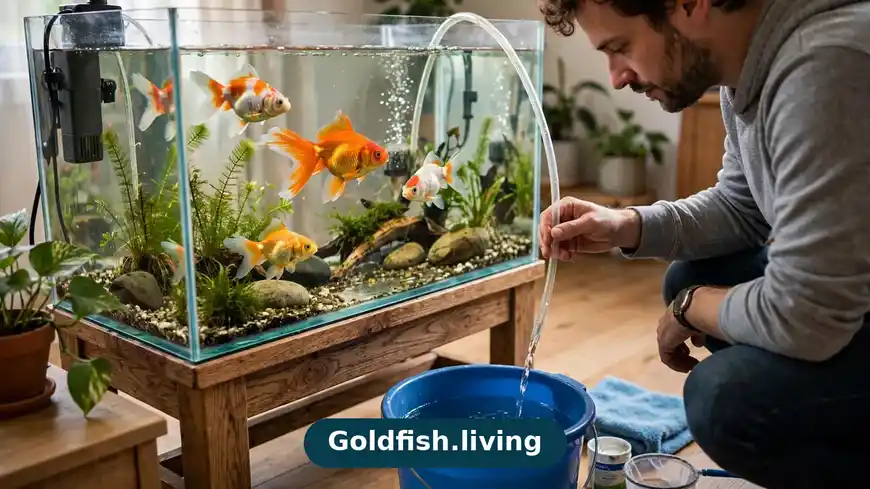
You need three things: a gravel vacuum siphon, a bucket, and a dechlorinator that handles both chlorine and chloramine. The vacuum removes water and waste in one motion, and the wide-tube versions clean a 20 gallon tank in under ten minutes.
Keep the bucket dedicated to the aquarium and label it, so nobody borrows it for mopping. Soap residue kills fish fast, and a bucket that has held cleaning chemicals should never touch tank water.
Buy the concentrated dechlorinator rather than the ready-diluted kind. A few drops treat gallons of tap water, so one small bottle lasts months and the cost per change drops to almost nothing.
Unplug the heater if the water level will drop near it, then siphon out 25 to 30 percent, pushing the gravel vacuum into the substrate to pull out trapped waste. Scooping water off the top alone leaves the real filth behind, rotting in the gravel and feeding nitrate.
Work the vacuum in sections, doing a different third of the tank each week. With sand substrate, hover the siphon just above the surface to lift waste without sucking up the sand itself.
Fill the bucket with tap water, dose dechlorinator for the full bucket volume, and check the temperature matches the tank within 2 to 3 degrees. Pour it back slowly, over 10 to 15 minutes, then plug everything in and confirm the filter restarts.
Never replace all the water at once. A 100 percent change wipes out stable chemistry and shocks the fish, however clean the result looks in the first hour.
New tanks run on a different clock
During fishless cycling there are no fish yet, so water changes are rarely needed. Once fish arrive in a new or still-maturing tank, test ammonia and nitrite daily instead.
Any reading above zero calls for an immediate 25 to 50 percent change with dechlorinated, temperature-matched water. Keep that up until readings hold at zero for a full week, with twice-weekly testing through the first month.
Our guide to cycling a goldfish tank explains the process end to end. The water testing schedule then shows which days to test and when the tank graduates to the normal weekly routine.
Graduation is a change of rhythm, not the end of testing. The weekly test before the weekly change stays in place for the life of the tank, because it is the habit that catches the next problem while it is still small.
Signs the schedule is too loose
Nitrate persistently above 40 ppm is the clearest signal. Stubborn algae, a slow pH slide, sluggish fish, and water that smells earthy or stale all point the same way.
If you spot them, do not do one giant change to catch up. Do 30 percent changes every two to three days until the parameters stabilize, then return to the weekly routine.
Testing is what turns these signs into an early warning instead of a post-mortem. A two-minute nitrate and pH check each week shows the trend while it is still cheap to correct.
Weeks that break the pattern
Some weeks legitimately break the routine. After medicating the tank, do a 30 percent change once treatment ends to remove residual medication, since carbon helps but fresh water finishes the job.
When new fish go in, test twice weekly for the first month because the bioload just jumped. During an algae bloom, smaller twice-weekly changes starve the algae more steadily than one big one.
If you have missed several weeks, ramp back gradually with 25 percent changes every two to three days. Jumping straight to a huge change shocks fish that have adapted to the dirty water.
Water change questions
Can you change too much water at once?
Yes, changes above 50 percent at once risk shocking the fish with sudden chemistry shifts. The exception is an ammonia or nitrite emergency, where a large change is the lesser evil, but otherwise smaller and regular beats big and rare.
Can tap water go straight in from the faucet?
Only after treating it. Tap water carries chlorine or chloramine that kills beneficial bacteria and burns fish gills, so dose dechlorinator for the volume you are adding, every single time.
Should the fish come out during a change?
No, netting and moving them stresses fish far more than staying put during a careful partial change. Work slowly, keep the siphon away from them, and they will barely notice.
Do water changes wash away the good bacteria?
No, because beneficial bacteria live on surfaces: filter media, substrate, glass, and decor. Very little lives free-floating in the water, so a partial change leaves the colony intact.
Does a big filter cancel the weekly change?
No, because filters process ammonia into nitrate but do not remove nitrate, replenish minerals, or dilute hormones. An oversized filter lets you stock slightly heavier, but it never replaces the bucket.
Same day, same bucket
Pick a day, keep the bucket and siphon stored together, and treat the water change like brushing your teeth: non-negotiable and quick. A 20 gallon change takes about fifteen minutes once the routine is set.
Consistent weekly changes are the backbone of everything else in goldfish keeping. Clean, stable water makes feeding, health, and even algae problems simpler, because the foundation is right.

8 Comments